
Radiofrequency ablation (RFA) side effects are mostly mild reactions such as pain at the treatment site, low fever and flu-like aches, and they usually settle on their own within 10 days. In an Italian multicenter study of 2,320 patients with liver tumors, major complications needing extra treatment occurred in 2.2%, and an analysis of 1,000 treatments at the University of Tokyo Hospital recorded no treatment-related deaths.
This guide draws on overseas studies covering thousands of patients treated with RFA in the liver, lung and kidney, plus patient information from hospitals in the United States and Canada. It explains common reactions, rare complications, rates by organ, life after the procedure and symptoms that need a call to the hospital. The procedure itself is covered in our guide to liver cancer RFA and recovery.
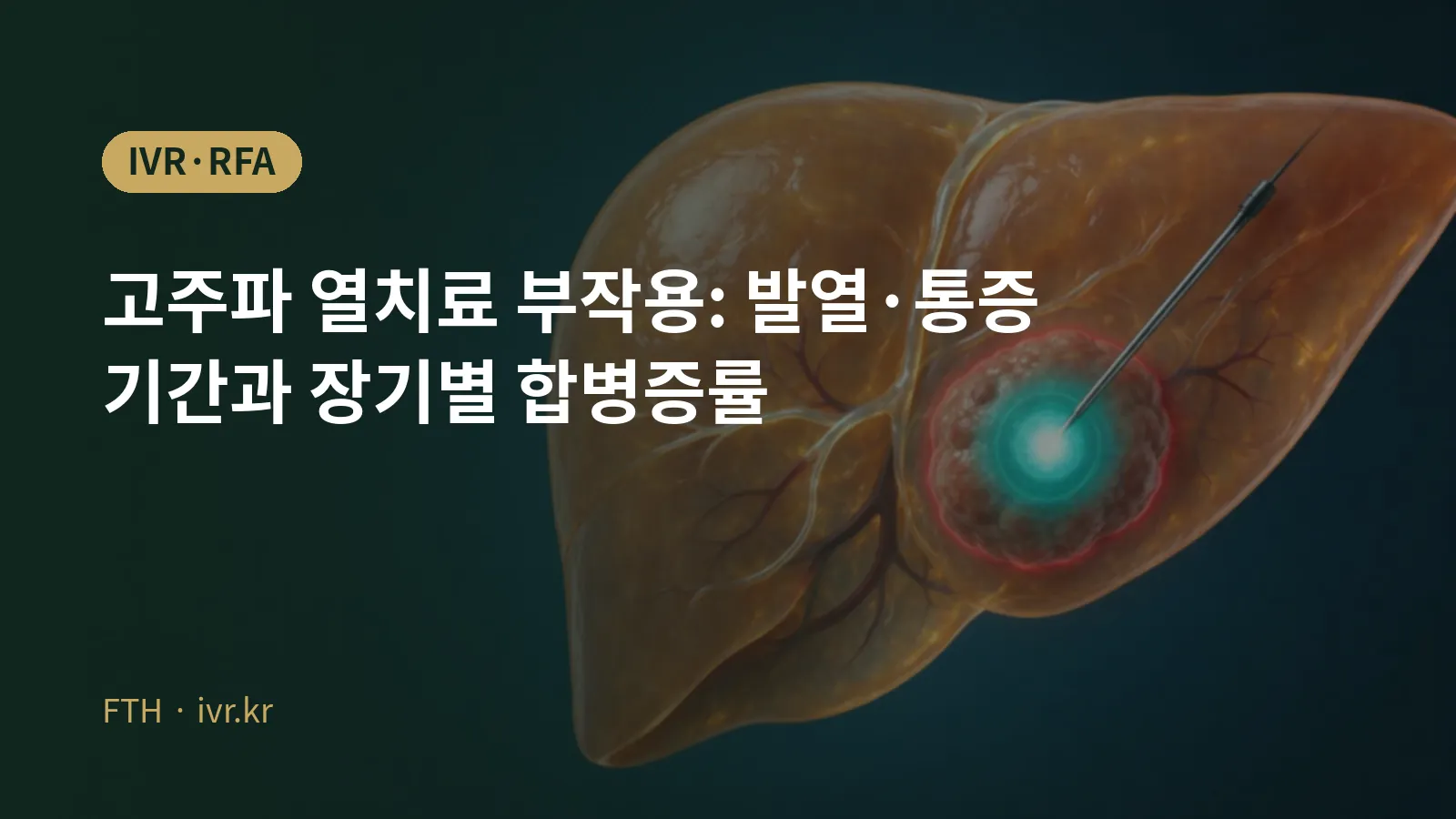
Treatment status · RFA is an established, approved treatment used in Japan, the United States and Europe for small liver, lung and kidney tumors, among others. All figures below come from studies of real patients and can vary with the hospital, equipment and tumor location. This article is general information, not a treatment recommendation.
Why side effects happen and how common they are
In RFA, a thin needle electrode is placed in the tumor and an electric current heats and destroys it. There is no large incision, so the strain on the body is lower than with surgery. However, the needle passes through skin and organs and a thin rim of tissue around the tumor is also heated, so some reactions can occur. The basics are explained on our RFA overview page.
Researchers divide side effects into two groups. The first is mild reactions that many patients notice, such as pain, low fever and tiredness, which pass within days. The second is complications that need their own treatment, such as bleeding or infection. In large studies these affected 2 to 4 in 100 liver patients and about 5 in 100 kidney RFA sessions.
Experience makes a clear difference. In a lung RFA series from Mie University in Japan, the major complication rate fell from 19% in the first 100 sessions to 8.8% in the following 900. This is why choosing a center with a high case volume matters.
The most common reactions: pain, low fever and post-ablation syndrome
A US research team followed 36 people treated with liver or kidney RFA using surveys on days 1, 3, 5 and 10. Post-ablation syndrome, meaning fever together with flu-like symptoms, developed in 12 (33%). Low-grade fever occurred in 15 (42%), flu-like symptoms in 29 (81%), and four people had no symptoms at all.
Symptoms peaked on day 3 and mostly resolved by day 10. Pain and interference with daily activities were greatest on day 1, and kidney patients recovered faster than liver patients. The authors concluded that the syndrome is self-limiting, but noted that fever that persists or appears late should be checked for infection or abscess.
| Reaction | How common | Usual course | Management |
|---|---|---|---|
| Pain at the treatment site | Most common | Worst on day 1, eases over a few days | Oral pain relief |
| Low-grade fever | 15 of 36 (42%) | Peaks on day 3, settles within 10 days | Fever medicine, fluids |
| Flu-like symptoms | 29 of 36 (81%) | Peak on day 5, usually gone within 10 days | Rest |
| Post-ablation syndrome (fever plus flu-like) | 12 of 36 (33%) | Resolves on its own within 10 days | Pain and fever medicine |
| Nausea, chills | Some patients | About 1 week | Symptom-based medicine |
Based on Wah TM, et al. Radiology 2005 (prospective survey of 36 patients) and UW Medicine patient education.
The Canadian Cancer Society also notes that pain, feeling unwell with a fever and, after kidney RFA, blood in the urine may occur for a few days. Most people return to normal activities within a few days.
Complication rates by organ
Complication rates depend on the organ treated. In the lung the needle must cross air-filled tissue, while in the kidney the urinary tract and nerves lie close by, so each organ has its own points of care. The table lists leading large studies for each organ.
| Organ and study | Patients | Major complications | Other findings |
|---|---|---|---|
| Liver · Italian multicenter (Radiology 2003) | 2,320 patients, 3,554 tumors | 2.2% (50 patients) | Minor complications under 5%, mortality 0.3% (6) |
| Liver · University of Tokyo (Cancer 2005) | 664 patients, 1,000 treatments | 4.0% per treatment (1.9% per session) | No treatment-related deaths, 5-year survival 54.3% in first-treatment patients |
| Lung · Mie University, Japan (2011) | 420 patients, 1,000 sessions | 9.8% (98 sessions) | 19% in first 100 sessions, 8.8% in next 900 |
| Kidney · Mayo Clinic, USA (JVIR 2012) | 573 procedures (254 RFA, 311 cryoablation) | RFA 4.7%, overall 6.6% | No deaths, mean hospital stay 1 day |
Studies count complications differently (per patient or per session, and by grading system), so use the figures to see trends rather than compare them directly.
The lung study counted all CTCAE grade 3 and 4 events as major. These included aseptic pleuritis (2.3%), pneumonia (1.8%), lung abscess (1.6%), bleeding needing transfusion (1.6%) and pneumothorax needing pleurodesis (1.6%). In the same study, one-year survival for patients with primary lung cancer was 89.6%.
For more detail see our lung cancer RFA guide and, for the kidney, long-term results of kidney cancer cryoablation.
Rare complications and how they are managed
Major complications are rare, but knowing what they look like helps you watch your recovery calmly. The Italian liver study reported peritoneal bleeding, tumor seeding along the needle track, liver abscess and bowel perforation.
- Bleeding: the needle track can bleed. This is why blood clotting is tested beforehand and blood thinners are adjusted. Most bleeding stops with observation; if needed it is treated with transfusion or embolization.
- Infection and abscess: pus can collect where the tumor was treated. UW Medicine gives antibiotics before the procedure to lower this risk. If it happens, it is treated with antibiotics and a drain.
- Heat injury to nearby organs: tumors close to the bowel, bile ducts or diaphragm can transmit heat. Among the 1,000 Tokyo treatments, there was one case each of bile peritonitis and duodenal perforation, both treated with surgery.
- Pneumothorax (lung): air can leak along the needle track. It usually improves with observation or a small tube to remove the air; pleurodesis was needed in 1.6% of sessions in the Mie study.
- Nerve and urinary tract injury (kidney): in the Mayo Clinic study, nerve and urothelial injury were the most common complications after RFA, and bleeding and blood in the urine after cryoablation.
- Tumor seeding: tumor growth along the needle track is very rare; it occurred in 1 of 1,000 sessions (0.1%) in the Mie lung study.
To lower these risks, doctors measure the distance between the tumor and nearby organs on CT or MRI before treatment. If the tumor sits too close, they may suggest a different ablation method or another treatment.
Life after the procedure
According to UW Medicine, patients rest for 2 to 6 hours in a recovery unit and most go home the same day. The Canadian Cancer Society says many people stay one night and some go home the same day. Length of stay varies by country, hospital and organ, so check in advance.
| Time | What to do and avoid |
|---|---|
| Day of procedure (24 hours) | No driving, alcohol or signing important documents; stay with a responsible adult and keep activity light |
| Days 2 to 3 (48 to 72 hours) | Do not lift more than 5 to 10 pounds (about 2.3 to 4.5 kg); avoid strenuous exercise |
| Needle site | Keep covered and dry for 24 hours, then shower; avoid baths and swimming until fully healed |
| A few weeks later | CT or MRI to confirm the tumor was fully treated |
| Afterwards | Imaging every 3 to 4 months to check for recurrence (as your hospital advises) |
Based on UW Medicine patient education (2024) and the Canadian Cancer Society.
Pain is usually controlled with oral pain relief, and fever with prescribed fever medicine and plenty of fluids. If sedation or anesthesia was used, you may feel dizzy for 24 hours, so it is safer not to move around alone.
Symptoms that need a call to the hospital
The symptoms below are uncommon, but if they appear, contact your treating hospital or an emergency department without waiting. The list follows UW Medicine patient information.
- Fever above 101°F (38.3°C) or chills
- Bleeding that does not stop after about 15 minutes of gentle pressure, or drainage from the needle site
- Worsening shortness of breath or new chest pain
- Dizziness or vomiting
- Yellowing of the eyes or skin (jaundice)
As the research shows, fever lasting more than 10 days, or fever that returns after settling, should be checked for infection such as an abscess. Because this can happen after you fly home, ask for the hospital's contact details and a written summary of your treatment.
What to check when treated in Japan or abroad
Japan has long used RFA as a local treatment for liver cancer, and its use is expanding to the lung, kidney and bone. Uses by cancer type are summarized in RFA results by cancer type. These questions are worth taking to your consultation.
- How many RFA procedures for my organ (liver, lung or kidney) does this hospital perform each year?
- Are there nearby organs that need special care given my tumor's location?
- How many days will I stay in hospital, and what are the discharge criteria?
- Whom do I contact about fever or pain after I return home?
- When and where will the follow-up CT or MRI be done?
To prepare, see also five questions before an RFA consultation and tests before liver cancer procedures.
Frequently asked questions
How long does fever last after RFA?
In a US prospective survey, low-grade fever occurred in 42% of patients, peaked on day 3 and mostly settled within 10 days. Contact the hospital at once if it goes above 38.3°C (101°F) or comes with chills.
Is radiofrequency ablation painful?
Sedation or anesthesia is used during the procedure, and pain afterwards is greatest on the first day. It is usually controlled with oral pain relief and eases over a few days.
How often do major complications occur?
They occurred in 2.2% of 2,320 patients in an Italian liver study and in 4.0% per treatment across 1,000 treatments at the University of Tokyo Hospital. For the kidney, the Mayo Clinic study reported 4.7% of RFA procedures.
When can I return to normal life?
The Canadian Cancer Society says most people return to normal activities within a few days. UW Medicine advises no driving for the first 24 hours and avoiding heavy lifting and strenuous exercise for 2 to 3 days.
This article summarises overseas official sources and studies as general information and is not medical advice. Discuss treatment choices with a doctor who has examined you.
Sources (checked October 31, 2026)
- Livraghi T, et al. Treatment of focal liver tumors with percutaneous radio-frequency ablation: complications encountered in a multicenter study. Radiology. 2003;226(2):441-451.
- Tateishi R, et al. Percutaneous radiofrequency ablation for hepatocellular carcinoma: an analysis of 1000 cases. Cancer. 2005;103(6):1201-1209.
- Wah TM, et al. Image-guided percutaneous radiofrequency ablation and incidence of post-radiofrequency ablation syndrome: prospective survey. Radiology. 2005;237(3).
- Kashima M, et al. Complications after 1000 lung radiofrequency ablation sessions in 420 patients: a single center's experiences. Mie University Graduate School of Medicine (AJR 2011).
- Atwell TD, et al. Complications following 573 percutaneous renal radiofrequency and cryoablation procedures. Journal of Vascular and Interventional Radiology. 2012;23(1):48-54.
- UW Medicine. Radiofrequency or Microwave Ablation to Treat Solid Tumors (patient education). 2024.
- Canadian Cancer Society. Radiofrequency ablation.